

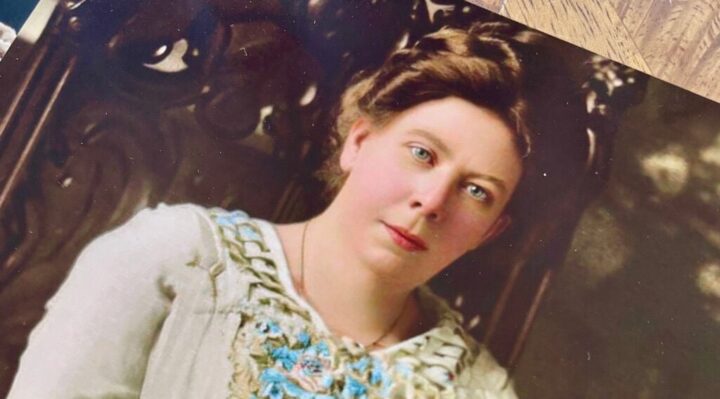
SPOKANE, Wash. — Her last name appears on buildings throughout Spokane, but May Arkwright Hutton’s story extends far beyond the wealth that made her family prominent in the region’s history.
May Arkwright was born into poverty in Ohio in July 1860. For reasons lost to history, she was sent to care for her blind grandfather.
She came west to Idaho just as mining exploded in the Silver Valley. She first worked as a cook, then ran a boarding house. It was there she met an orphan-turned-train engineer named Levi Hutton.
The pair invested in the Hercules mine, which awakened May’s passion for workers’ rights and the labor movement. Even when the mine struck a vein of silver and made them very rich, May was determined to use her voice to help others.
“You see who someone’s character really is by the legacy they leave behind,” said Anna Harbin, Curator of Archives and special collections at the MAC Museum.
Harbin oversees collections that explore Spokane’s history. The boxes containing the Huttons’ letters, pictures and scrapbooks is a popular one.
“She’s unique because she’s a rags to riches story,” Harbin said.
May ran for office in Idaho in 1904, then the couple moved west to Spokane. They built a four-story building in downtown Spokane and moved into the top floor.
That building on South Washington now bears their name.
In Washington, she found herself back in time. Washington women had not yet earned the right to vote.
That prompted May to lend her formidable voice to the suffrage movement, though her approach differed from other activists of the time.
“A lot of the suffragettes were more poised and wanted to keep things a little bit on the down low. She was very much in your face,” said Trinity Kinville, a high school senior who has studied May’s boldness and history.
Six feet tall and more than 220 pounds, May didn’t blend into the background. The Seattle contingent of suffragettes thought she was too bold, too loud, too crass. She liked low-cut dresses and bold statements. She had the confidence of a woman well before her time.
“Levi was sort of low profile,” said Chud Wendle, executive director of the Hutton Settlement. “He stood alongside her – she did the talking. And she made a difference. She truly did make a difference.”
May’s scrapbooks hold page after page of news clippings about her political exploits. The boxes in her archive contain political speeches she made across the Pacific Northwest, with edits made in her own hand.
Washington women finally earned the right to vote in 1910 and May was among the first to cast a ballot in Spokane County. She also became the first woman to serve on a Spokane County jury and one of the first women to attend the Democratic National Convention.
She also used her voice took that bold approach to advocate for unwed mothers and orphaned children.
“She would write a letter to somebody and be like, ‘Hey. I know you left town, and you’re happily at home with your wife. But you have a woman here with a child that you owe money to – and if you don’t send the money back, you’ll be hearing from my lawyers,'” Harbin said.
Her political aspirations are even reflected in the Huttons’ beautifully-maintained home on Spokane’s south hill.
She referred to the home’s large wraparound porch as her ‘victory porch’.
“[Her] victory porch for when [she would] become the first female president of the United States,” Wendle said. “That’s her – and I think she could have been.”
May Arkwright Hutton never got that chance. She died from kidney disease in 1915 in the beautiful home she loved so much.
In his grief, her husband Levi turned to a project that would far outlive him.
The former orphan built the Hutton Settlement on more than 300 acres in what is now Spokane Valley.
Since 1919, the settlement has been home for hundreds of children who have been neglected, orphaned or abused.
“I can feel the love here,” said Kinville, who has lived here off and on since she was a child. “Every little detail at Hutton was sculpted with the utmost care.”
Kinville is about to graduate from high school and head to college, thanks to the stability and support of the Hutton Settlement.
The right to vote was world-changing, but May Arkwright Hutton’s legacy represents more than May could have ever hoped for.
“I definitely think May has given me a lot of courage to be who I want to be and be the change I want to see in the world. And not be afraid if people are trying to drown out my voice,” Trinity said.
You can read more about the Hutton Settlement and its history at this link.
© 2026 KAYU FOX 28. All rights reserved. Content may not be reproduced, distributed, or transmitted without written permission.