

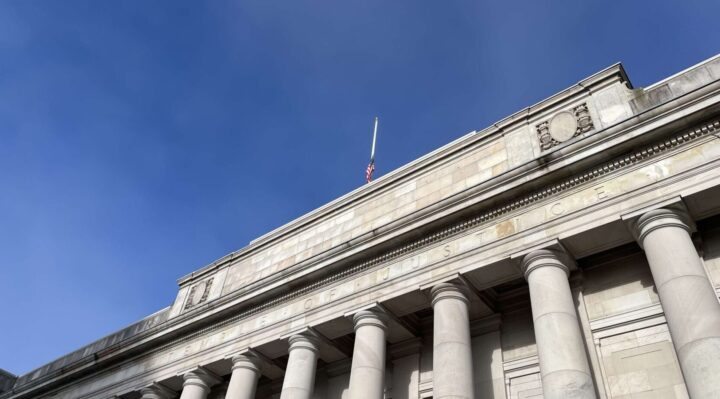
Washington’s Supreme Court on Monday denied a conservative political committee’s request to pursue an attempt to repeal the state’s new income tax law with a referendum this fall.
The opposition can still move forward with an initiative to overturn the tax on millionaire earners. But that path to challenging the law will require twice as many signatures to advance.
In the ruling, justices said the income tax’s so-called “necessity clause,” which shields it from referendum, is valid.
The law “undisputedly generates revenue for the state’s existing institutions and hence is similarly subject to the ‘support of state government’ exception to the referendum power,” reads the decision signed by Chief Justice Debra Stephens.
Stephens notes the order is “consistent with the words of the constitution and our unbroken line of precedent.” The decision doesn’t provide a tally of the vote among the justices.
Brian Heywood, whose Let’s Go Washington group filed the challenge, said he disagrees with the decision, arguing it gives Democratic leaders “a blank check to spend beyond their means and raise taxes later, and the people don’t get to weigh in.”
“This ruling states that the people cannot challenge via referendum any tax imposed by the legislature, removing any guardrails from the people on runaway spending,” Heywood said in a statement.
On the other side, House Majority Leader Joe Fitzgibbon, D-Seattle, said the ruling wasn’t a surprise.
“But it’s still good news for what we did this session and tax reform in Washington,” said Fitzgibbon, who spearheaded the income tax legislation with Senate Majority Leader Jamie Pedersen.
Tax opponents would have needed to submit signatures of 154,455 registered voters by June 10 to qualify for the fall ballot. State election officials recommend submitting at least 195,000 to account for invalid signatures.
Opponents of the tax would need to turn in 308,911 signatures by July 2 to get an initiative on the ballot this year, or by Dec. 31 if they opt for an initiative to the Legislature.
Emergency petition
Heywood, the hedge fund manager and chief financier of Let’s Go Washington, filed a referendum soon after Gov. Bob Ferguson signed the so-called “millionaires’ tax” into law on March 30. It imposes a 9.9% levy on household wage income above $1 million starting in 2028.
Secretary of State Steve Hobbs rejected the referendum, citing a provision toward the end of the 109-page legislation expressly prohibiting such a vote.
That language says the tax “is necessary for the support of the state government and its existing public institutions.” By inserting this, Democratic lawmakers leave an initiative as the only option for opponents.
Heywood filed an emergency petition asking justices to direct Hobbs to process the referendum paperwork. Justices considered the request during their conference Thursday.
Attorney Joel Ard, representing Heywood and the committee, argued in court filings that with tax collections not starting until 2029, it negated “any honest claim” that the bill is necessary for the support of state government. They viewed this as a ruse to block the referendum.
State attorneys argued the petition should be rejected because Heywood should have first sought relief from a lower court and, if rebuffed, appealed to the state’s high court. And they said that lawmakers, after much debate, retained the necessity clause. They urged the court to defer to the Legislature.
Email controversy
Since each side submitted their original briefs, the state attorney general’s office produced a trove of public records revealing the extent to which lawmakers sought state lawyers’ advice in drafting and honing language to achieve the bill authors’ goals.
Among them was a Dec. 11, 2025, email from Solicitor General Noah Purcell to Pedersen, prime sponsor of Senate Bill 6346. This email, first reported by The Center Square, points out that the version at that time lacked an emergency clause.
“Without one, someone could try to subject the bill to a referendum. It should not be subject to referendum because it raises revenue, but under the Secretary of State’s long standing practice, they only reject proposed referenda if the bill has an emergency clause, so someone would have to sue to prevent a referendum on the bill as written. I just wanted to make sure you were aware of that,” Purcell wrote.
Ard submitted this email to try to bolster his argument that sponsors intentionally included the necessity clause to avoid a referendum.
Pedersen said Monday that he didn’t think the necessity clause was needed because tax measures aren’t subject to referendum. But adding that language to make it explicit sped up the legal process to get a ruling from the state Supreme Court, as opposed to more protracted litigation, he said.
“That’s all the solicitor general was advising me on in those emails,” Pedersen said.
Attorney General Nick Brown has said these sorts of conversations are common as lawmakers seek legal advice on legislation. After Monday’s ruling, Brown spokesperson Mike Faulk said it “ought to further put to bed the brazen falsehood that a revenue bill was ever going to be subject to referendum if not for pesky AG staff dutifully and ethically advising legislators.”
This won’t be the state high court’s last word on the income tax, as it will need to weigh in on its constitutionality before collections can begin.
The Citizen Action Defense Fund filed a lawsuit April 9 challenging the constitutionality of the income tax. Rob McKenna, a former state attorney general and 2012 Republican candidate for Washington governor, and Phil Talmadge, a former state Supreme Court justice, are leading the litigation.
Washington State Standard is part of States Newsroom, a nonprofit news network supported by grants and a coalition of donors as a 501c(3) public charity. Washington State Standard maintains editorial independence. Contact Editor Bill Lucia for questions: info@washingtonstatestandard.com.
© 2026 KAYU FOX 28. All rights reserved. Content may not be reproduced, distributed, or transmitted without written permission.