

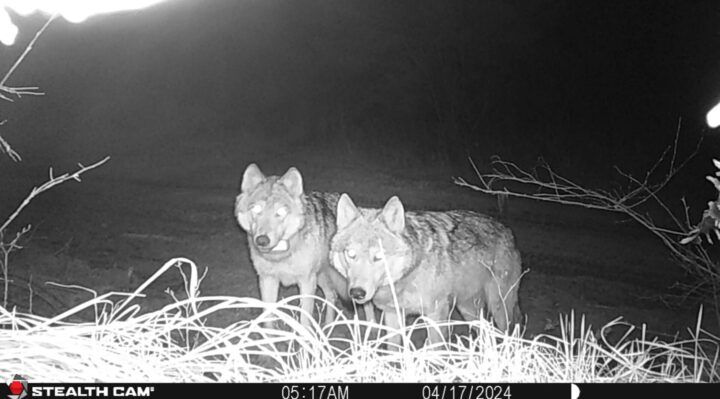
KETTLE FALLS, Wash. — Wolves are back in Washington, and that’s creating a big problem for cattle ranchers.
The state’s wolf population grew 17% last year to 270 wolves across 49 packs. It’s a huge win for conservationists because wolves were nearly wiped out across the West by the 1930s. But for ranchers in northeastern Washington, it’s costing them their way of life.
However, the recovery has intensified conflicts with cattle ranchers in Ferry and Stevens counties, where agricultural census data reveals a troubling trend for the industry.
Ferry County has experienced a 33.6% decrease in farms raising beef cattle, while Stevens County numbers dropped nearly 6%. The decline follows a nationwide trend.
“Ferry county in particular it’s the canary in the coal mine, you can look at it and see what’s happening to it, and it is absolutely devastating to that county,” said Scott Nielson, president of the Stevens County Cattlemen’s Association.
Ryan Tracy runs cattle in the hills around Kettle Falls and has dealt with multiple wolf attacks. Despite everything, he’s not giving up.
“Regardless of the difficulty of this, I love this way of life,” Tracy said.
The conflict extends beyond individual attacks. Ranchers describe wolves as creating ongoing stress for their cattle, leading to reduced weight gain and fewer pregnancies.
“When wolves are in your cattle, your dead ones are the least of your worries,” said Jeff Flood, a wildlife specialist with the Stevens and Ferry County Sheriff’s Office who serves as a liaison between ranchers and state fish and wildlife officials.
Flood breaks down the math: “All of the sudden you’ve got calves that are 25 pounds light, we’re selling 2.50 dollars a pound on beef 3 dollars and we’ve got 300 calves here and they’re all 25 pounds light.”
Current state regulations severely restrict ranchers’ ability to protect their livestock. Ranchers cannot kill wolves that attack their cattle unless the wolves are caught in the act in certain parts of eastern Washington. Violations can result in thousands of dollars in fines and jail time.
The situation is further complicated by jurisdictional issues, as wolves on tribal lands in the region are managed separately by the tribes rather than the state.
Last year, the state documented 17 wolf attacks on livestock, down from 40 the year before. But WDFW admits depredations likely go unreported.
“Not reporting suspected depredations, not only makes it impossible for WDFW to address the conflict for that particular producer, it also may put neighboring producers at risk if depredations escalate,” Subhadeep Bhattacharjee, Wolf and grizzly bear policy lead for the Washington Department of Fish and Wildlife stated in an email.
While state law requires Fish and Wildlife to compensate ranchers for wolf-caused damages, determining losses proves challenging. The agency received only four direct and five indirect claims last year. That’s fewer than the number of confirmed attacks.
Tracy reported his first livestock attack, which led to a lengthy court battle with the state. “I set a precedent of which I don’t intend ever to utilize, but I did that because I think that’s what a good neighbor should do,” he said.
Ranchers say the state has a 300-page wolf plan but isn’t following it.
“This isn’t a wolf problem, this is a management problem,” Flood said.
For conservationists, the wolf recovery represents a major success. Eastern Washington hit its recovery goals 12 years ago.
“Eastern Washington recovery objectives have been met for the past 12 years, we just haven’t had those four breeding pairs in the South Cascades yet, and that’s kind of the last remaining recovery area,” said Trent Roussin a biologist with the WDFW.
But ranchers worry they’re being pushed out. Between harsh winters, expensive land, rough terrain, and now more hungry predators, many are calling it quits.
“Ranchers are going out of business and from my perspective I can’t see where the department, WDFW is doing anything to help,” Nielson said, worried about what this means for rural communities.
The tension keeps growing along with the wolf population. As Flood puts it: “If we don’t get some of these wolf issues dealt with, it’s going to be bad here I think.”
© 2026 KAYU FOX 28. All rights reserved. Content may not be reproduced, distributed, or transmitted without written permission.