

SPOKANE, Wash. —This year marks the 250th anniversary of the United States, and KXLY is sharing stories of how the Inland Northwest helped shape America’s history.
One of the ideals America is known for is equal access to education and information. Much of that foundation can be traced to Andrew Carnegie, nicknamed the founder of modern philanthropy. His investment in public libraries helped shape communities across the country, including right here in Spokane.
In the early 1900s, the concept of free public libraries was revolutionary. Most people lacked the financial means to purchase books, which were costly and often inaccessible to working-class families.
“People didn’t have a lot of money back then. Books were expensive,” said Megan Duvall, historic preservation officer.
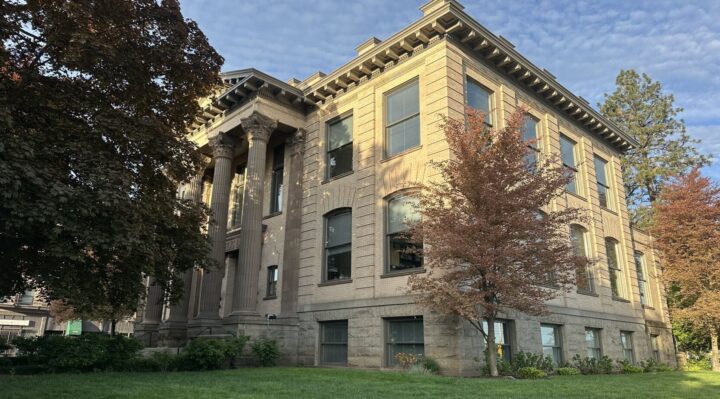
After years of struggling to build its own library system, Spokane turned to Carnegie for assistance. In 1904, the city received a grant that funded construction of an impressive main branch Carnegie Library on Cedar Street.
“This was a place you could come and actually sit down with a book and also a community space,” Duvall said.
By 1914, Spokane had constructed several additional Carnegie-funded branches, including the Heath Branch on Mission and the Monroe Branch on Montgomery. Carnegie’s total contribution to Spokane’s libraries reached $155,000, equivalent to nearly $6 million in today’s currency, according to the Spokane Public Library.
“These buildings really created the foundation for the library system you see in Spokane today,” said Amanda Donovan, director of communications for the Spokane Public Library.
The architectural firm Integrus, which now occupies the former Cedar location, has worked to preserve the building’s historic character while adapting it for modern office use. The restoration efforts have maintained many original features from the building’s library days.
“It is one thing to read about a building that used to exist, it is quite another thing to have the tangible actually existing building, to walk into and think about the people that were here before you,” Duvall said.
Carnegie became one of the richest men in history from his work in the steel industry. However, the majority of his fortune was donated to education and public library access. His library initiative created spaces where knowledge became accessible to everyone, regardless of economic status.
While none of Spokane’s Carnegie buildings currently function as libraries, their influence persists in the robust public library system they helped establish.
“The library was a place for connection and reading in 1906, and it is a place for connection and reading today,” Donovan said.
Each building now serves as office space and holds designation on the National Register of Historic Places.
Carnegie’s vision extended far beyond Spokane, funding more than 2,500 libraries worldwide, an investment predicted to be worth billions in today’s dollars.
“We have him to thank for the library system all across the country including here in Spokane,” Donovan said.
© 2026 KAYU FOX 28. All rights reserved. Content may not be reproduced, distributed, or transmitted without written permission.