

By Dean Murray
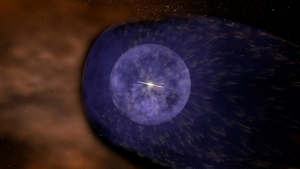
For the first time, a much younger version of the Sun has been caught “blowing bubbles” in the galaxy.
Astronomers using NASA’s Chandra X-ray Observatory have revealed the bubble – called an “astrosphere” – surrounds the juvenile star.
They said: “Winds from the star’s surface are blowing up the bubble and filling it with hot gas as it expands into much cooler galactic gas and dust surrounding the star.”
The Sun has a similar bubble around it, which scientists call the heliosphere, created by the solar wind. It extends far beyond the planets in our solar system and protects Earth from damaging particles from interstellar space.
This is the first image of an astrosphere that astronomers have obtained around a star similar to the Sun. It shows slightly extended emission, rather than a single point of light as seen for other such stars.
“We have been studying our Sun’s astrosphere for decades, but we can’t see it from the outside,” said Carey Lisse of Johns Hopkins University in Baltimore, who led the study, which was recently published in the Astrophysical Journal. “This new Chandra result about a similar star’s astrosphere teaches us about the shape of the Sun’s, and how it has changed over billions of years as the Sun evolves and moves through the galaxy.”
The star is called HD 61005 and is located about 120 light-years from Earth, making it relatively close. HD 61005 has roughly the same mass and temperature as the Sun, but it is much younger, with an age of about 100 million years, compared to the Sun’s age of about 5 billion years.
Because it is so young, HD 61005 has a much stronger wind of particles blowing from its surface that travels about three times faster and is about 25 times denser than the wind from the Sun. This amplifies the process of astrosphere bubble-blowing and mimics how our Sun was behaving several billion years ago.
Astronomers have nicknamed the HD 61005 star system the “Moth” because it is surrounded by large amounts of dust patterned similarly to the shape of a moth’s wings when viewed through infrared telescopes.
“We are impacted by the Sun every day, not only through the light it gives off, but also by the wind it sends out into space that can affect our satellites and potentially astronauts travelling to the Moon or Mars,” said co-author Scott Wolk of the Center for Astrophysics | Harvard & Smithsonian (CfA). “This image of the astrosphere around HD 61005 gives us important information about what the Sun’s wind may have been like early in its evolution.”