


Photo Credit: Voronaman / Shutterstock
As global talent mobility, technological innovation, and workforce development continue to shape the U.S. economy, the H-1B visa program plays an increasingly important role at their intersection. The visa program allows American companies to temporarily employ foreign workers in specialty occupations to meet demand for high-skilled talent. Most commonly in technology, engineering, healthcare, and professional services, the H-1B program has become both a critical workforce pipeline and a focal point of political and economic scrutiny.The program exists largely because of a persistent mismatch between the supply of specialized labor and employer demand in the U.S. economy. Even as overall employment has rebounded in recent years, many firms report difficulty filling roles that require advanced technical or scientific training, particularly in fast-growing or innovation-driven industries.
To maintain economic growth while also addressing concerns that foreign hiring could undercut domestic workers, federal rules require employers to pay H-1B workers at least the prevailing wage for their occupation and location, attest that no qualified U.S. workers are being displaced, and comply with strict labor condition and reporting requirements.
Understanding where and how heavily employers rely on H-1B workers has therefore taken on renewed importance. It is against this backdrop that analysts from Manifest Law—a modern immigration law firm focusing on work visas—examined patterns in H-1B new hires, denial rates, and geographic and industry concentration, using the latest data from U.S. Citizenship and Immigration Services.
By mapping H-1B usage across states, cities, and sectors, the analysis highlights which parts of the U.S. economy are most dependent on the program, and where shifts in policy or enforcement may have the greatest impact.
Here are the key takeaways from the analysis:
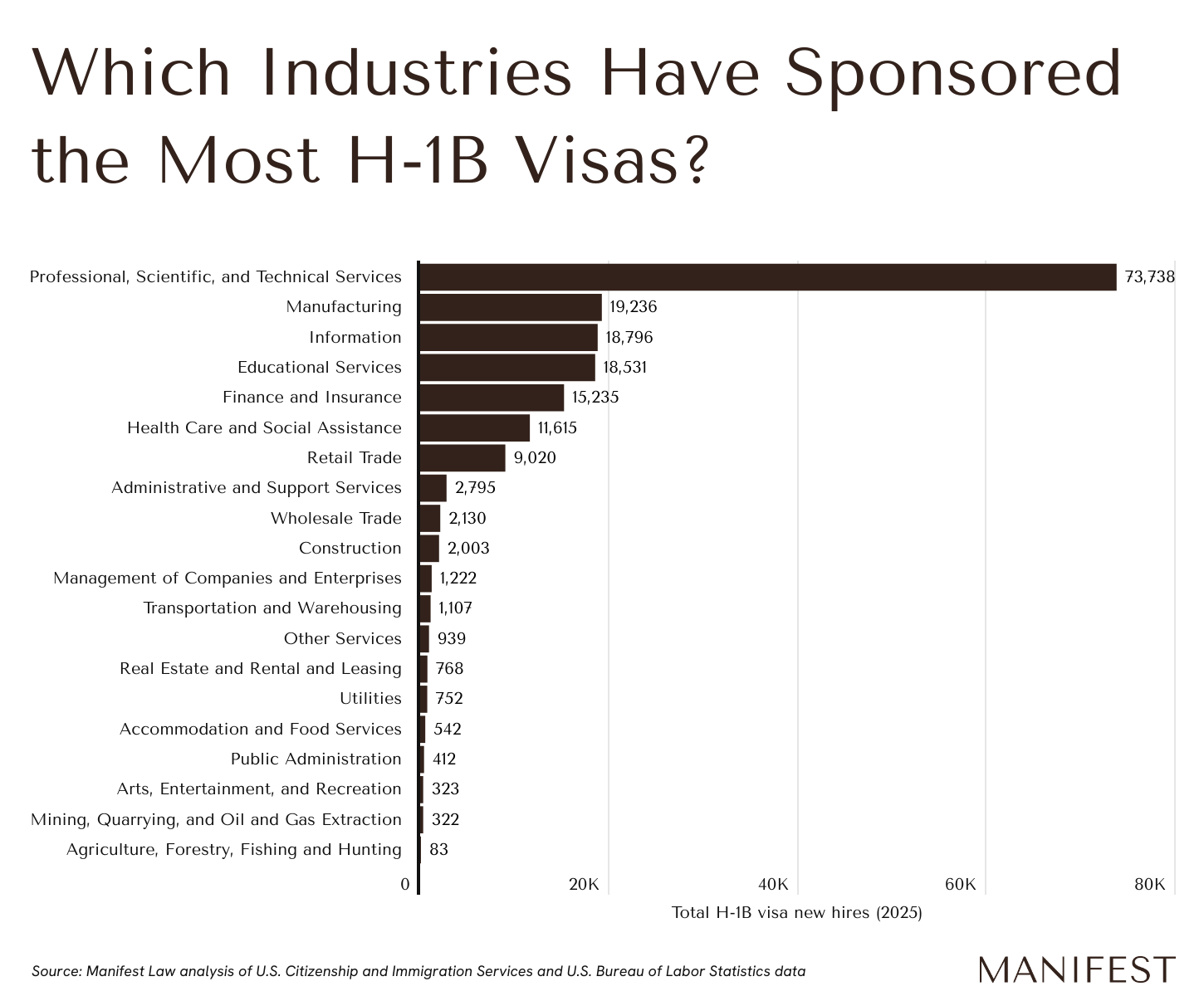
- Professional services and tech dominate H-1B sponsorship. The Professional, Scientific, and Technical Services sector accounted for 73,738 approved H-1B new hires, more than the next four industries combined.
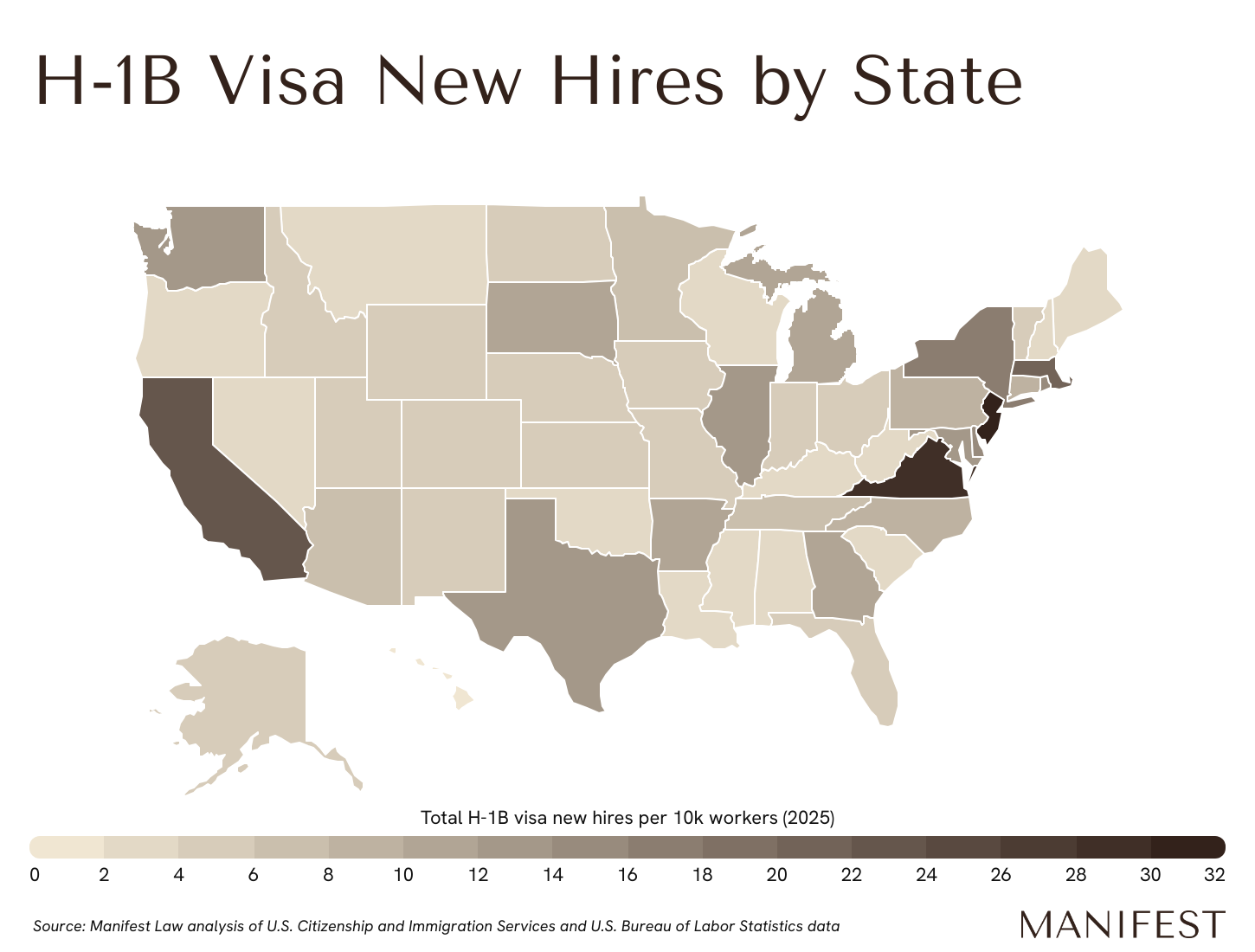
- H-1B hiring is highly geographically concentrated. While California accounts for more than 21% of approved H-1B new hires, states such as New Jersey and Virginia rank higher when measured by H-1B hires relative to overall employment, indicating a deeper dependence on the program than other larger labor markets.
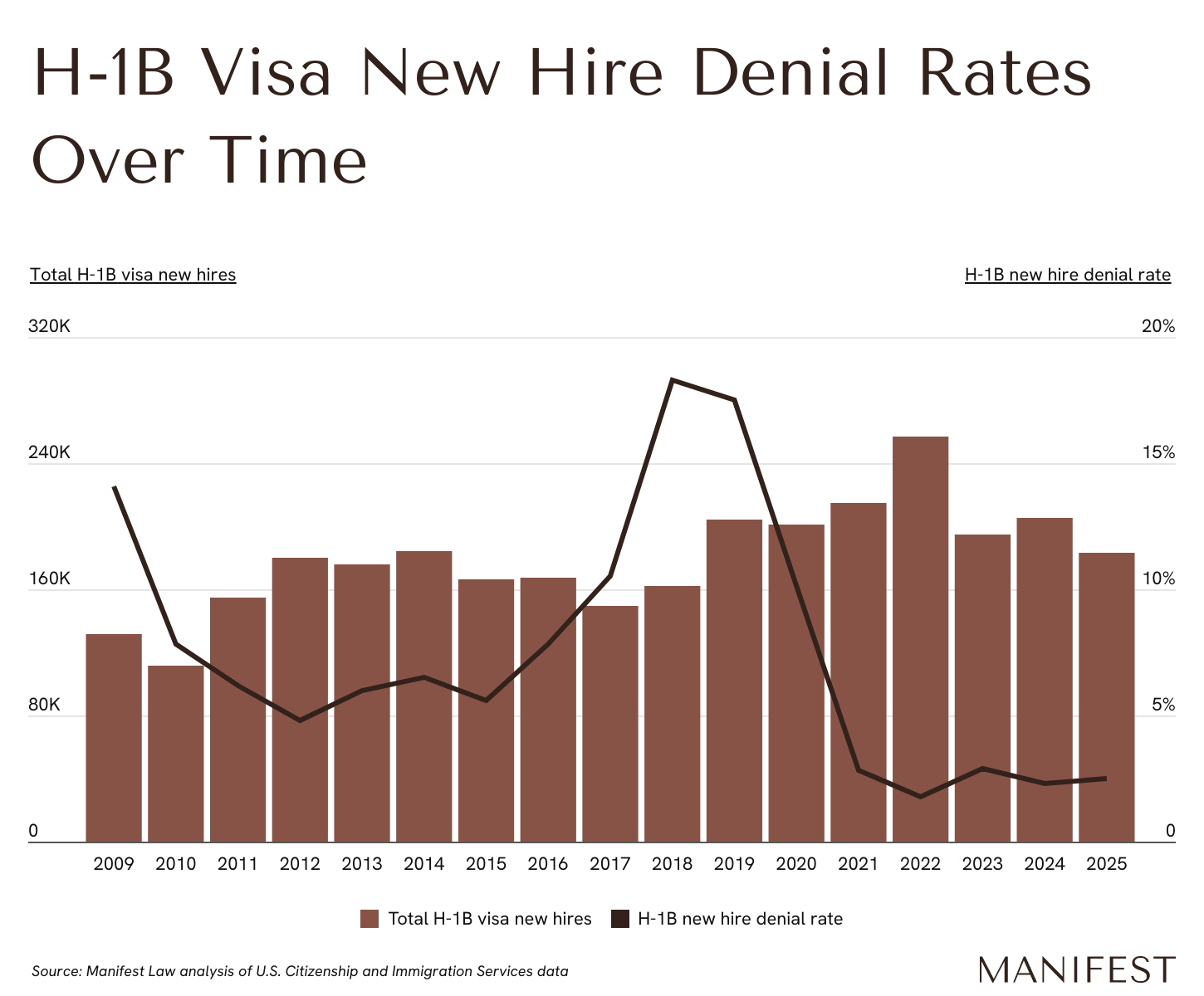
- H-1B new hire denial rates are near historic lows. After rising sharply to 18.3% in 2018, denial rates for new H-1B petitions have remained below 3% over the past 5 years, reducing approval uncertainty for employers nationwide.
Which Industries Have Sponsored the Most H-1B Visas?
Professional services and the tech industry sponsor more H-1B visa new hires than the next four industries combined
Source: Manifest Law analysis of U.S. Citizenship and Immigration Services and U.S. Bureau of Labor Statistics data | Image Credit: Manifest Law
H-1B sponsorship is heavily concentrated in a small number of industries, reflecting where U.S. employers most depend on high-skilled foreign labor. Nationally, the Professional, Scientific, and Technical Services sector accounts for the largest share of approved H-1B new hires, with 73,738 workers sponsored in 2025. This category—which includes a broad mix of professional occupations, from legal and accounting services to consulting, engineering, and scientific research—alone represents roughly 40% of all H-1B new hires across industries.
Other major sponsoring industries trail well behind. Manufacturing (19,236), Information (18,796), Educational Services (18,531), and Finance and Insurance (15,235) together account for 70,798 new H-1B hires—still fewer than Professional, Scientific, and Technical Services alone. When combined with the Information sector, often used as a proxy for core technology employment, professional services and tech-related industries account for more than half of all H-1B new hires nationwide, while sponsorship drops sharply across most other sectors.
H-1B Visa New Hires by State
While California leads in total volume, New Jersey and Virginia have the highest concentrations of H-1B new hires
Source: Manifest Law analysis of U.S. Citizenship and Immigration Services and U.S. Bureau of Labor Statistics data | Image Credit: Manifest Law
H-1B hiring varies widely across states, reflecting differences in industry mix, labor market size, and employer demand for specialized skills. In absolute terms, large and economically diverse states account for a disproportionate share of new H-1B hires nationwide, with the highest volumes concentrated in states that host major technology, professional services, and research hubs.
California leads by a wide margin, with 39,664 approved H-1B new hires in 2025—more than one in five nationwide. Texas (19,821) and New York (16,433) follow, together accounting for a substantial share of total hires. However, when measured relative to workforce size, smaller states rank higher: New Jersey (30.5) and Virginia (29.4) record the highest number of H-1B new hires per 10,000 workers, exceeding California (22.0) and indicating a deeper dependence on the program in certain Mid-Atlantic and Northeast labor markets.
Large Cities That Rely Most on H-1B Visa Employees
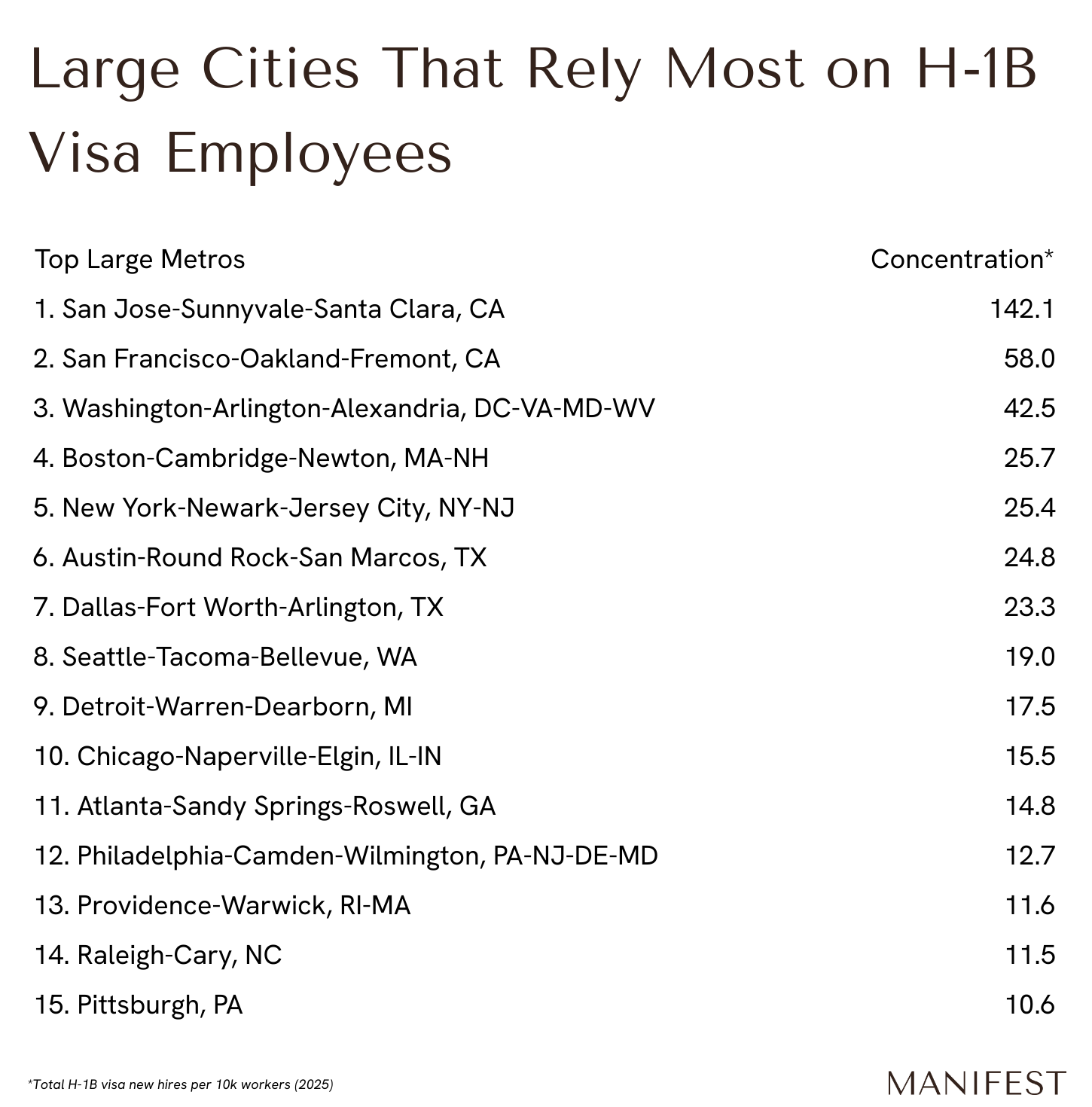
At the metropolitan level, H-1B hiring is even more concentrated. Tech- and research-oriented metros dominate when measured on a per-worker basis, led by San Jose, CA, which recorded 142.1 new H-1B hires per 10,000 workers in 2025. Smaller college- and research-driven metros, such as College Station, TX and Princeton, NJ, also rank among the highest by concentration, while large metros including New York and San Francisco account for the largest raw totals. Together, these patterns show that while H-1B hiring is anchored in major population centers, reliance on the program is often most pronounced in smaller, specialized regional economies.
H-1B Visa New Hire Denial Rates Over Time
After a sharp increase in scrutiny during the late 2010s, the H-1B new hire denial rate is near all-time lows
Source: Manifest Law analysis of U.S. Citizenship and Immigration Services data | Image Credit: Manifest Law
Denial rates for new H-1B petitions have varied markedly over time, closely tracking shifts in federal immigration policy and enforcement priorities. From 2009 through the mid-2010s, denial rates generally remained in the single digits, falling to 4.8% in 2012 as adjudication standards were relatively stable. That pattern changed during the first Trump administration, when U.S. Citizenship and Immigration Services (USCIS) increased scrutiny of employer petitions and narrowed interpretations of specialty occupation requirements. As a result, the new-hire denial rate rose sharply from 7.8% in 2016 to a peak of 18.3% in 2018, remaining elevated at 17.5% in 2019.
The trend reversed following the transition to the Biden administration, which rescinded or revised several restrictive policy memos and directed USCIS to return to pre-2017 adjudication standards. By 2021, the denial rate for new H-1B hires had fallen to 2.8%, and it has remained below 3% in every year since. Although denial rates have held steady into the second Trump administration, significant changes—such as the $100,000 H-1B petition fee and prevailing wage revisions aimed at reducing program abuse and protecting the American worker—are set to take effect in 2026 and onward. These changes could disrupt relatively stable H-1B approval outcomes.
For more information on how the analysis was conducted, see the methodology section. For complete results, see Which U.S. Cities & Industries Rely Most on H-1B Visa Employees? on Manifest Law.
Looking Ahead at the H-1B Landscape
The data show that reliance on the H-1B program is not evenly distributed across the U.S. economy, but instead concentrated in specific industries, states, and metropolitan areas where demand for specialized talent consistently outpaces domestic supply. Even as denial rates have fallen to near historic lows, employers in professional services, technology-related fields, and research-driven regions remain the most exposed to changes in how the program is administered.
Looking ahead, policy shifts rather than demand appear most likely to shape near-term H-1B outcomes. While adjudication standards have so far remained relatively stable during the current Trump administration, forthcoming changes—including higher filing fees and revised wage requirements—are expected to raise the cost of participation for employers. These changes may disproportionately affect smaller firms, startups, and organizations in mid-sized labor markets that rely on H-1B workers but have fewer resources to absorb higher compliance costs.
At the same time, the persistent geographic and industry concentration highlighted in this analysis suggests that any future tightening or expansion of the program would have uneven economic effects. Regions and sectors with deep dependence on H-1B workers could see more immediate labor market impacts, while others may be less affected. As policymakers continue to debate the role of high-skilled immigration, understanding where the H-1B program matters most provides critical context for evaluating how changes to the system may ripple through the broader U.S. economy.
Methodology

Photo Credit: Voronaman / Shutterstock
To determine the locations and industries most reliant on H-1B visa employees, researchers at Manifest Law analyzed the latest data from U.S. Citizenship and Immigration Services’s (USCIS) 2025 H-1B Employer Data Hub and the U.S. Bureau of Labor Statistics’s (BLS) Current Employment Statistics. Locations were ranked by the total H-1B visa new hires per 10,000 workers in 2025. H-1B new hires were considered to be new employment approvals, new concurrent approvals, and change of employer approvals. While the U.S. Congress mandates an annual cap for H-1B employment of 85,000 (65,000 standard and an additional 20,000 for the advanced degree exemption), there are additional exemptions for employers in higher education, non-profit research, and governmental research. BLS employment data was for nonfarm workers and was calculated using data from October 1, 2024 through September 30, 2025 in order to align with the USCIS’s fiscal year data.
The researchers also calculated total H-1B visa new hires, total H-1B visa approvals per 10,000 workers, total H-1B visa approvals, total workers, and the industry with most H-1B visa approvals. Total H-1B visa approvals includes continuation approvals, change with same employer approvals, and amended approvals.
For relevance, only locations with complete data and at least one approved H-1B new hire were included in the analysis. Additionally, metropolitan areas were grouped into the following population cohorts: small (less than 350,000), midsize (350,000-1,000,000), and large (more than 1,000,000).
For complete results, see Which U.S. Cities & Industries Rely Most on H-1B Visa Employees? on Manifest Law.