

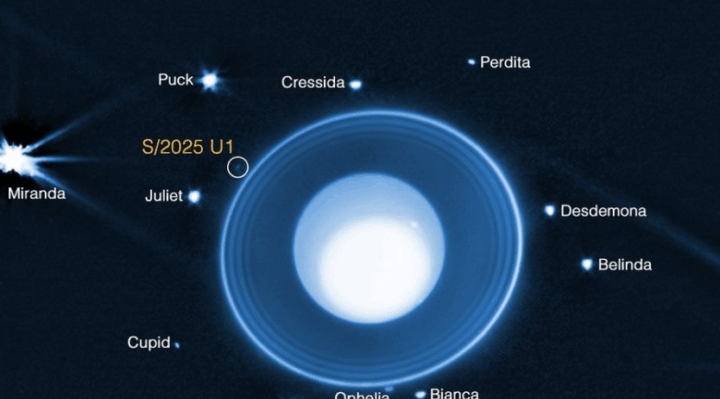
A NASA research team including the University of Idaho Physics Professor, Dr. Matthew Hedman, discovered a new moon orbiting Uranus. The team used imagery captured from NASA’s James Webb Space Telescope (JWST) to visualize the planet’s 29th confirmed moon, among the planet’s smallest moons.
“Our group at the University of Idaho has been looking into Uranus’ moons for quite some time. They are very complicated and very puzzling. There are aspects to this system we don’t fully understand. We’ve been trying to make sense of it with old data, but now with the launch of the James Webb telescope, we were part of a group that got the best images of Uranus in a long time. Digging through these, we found a moon that nobody had seen before,” said Hedman.
Using JWST’s Near-Infrared Camera, the scientists captured 10 40-minute, long-exposure images. The newly identified moon joins a fleet of smaller moons on tightly looping paths around the planet.
“Uranus is surrounded by a whole collection of both rings and moons. There is a set of midsized moons. They’re round. They’re smaller than Earth’s moon but they don’t look like it. They’re covered with craters. They have other weird features. Then there’s an entire collection of smaller moons. Some orbit way far out. Some orbit really close to Uranus, just outside its rings. That’s where we were looking and found this new object,” said Hedman.
Computer simulations of Uranus and its moons show that the smaller moons orbit so close together that their gravitational pulls tug on each other, likely making them bump together sometimes.
Hedman’s primary contribution was helping process the imagery from JWST.
“As soon as the first images were coming down, we were realizing, “Oh, this is going to be useful.” Part of this project was to also use other pictures to try to understand the Uranian system. It worked out! We were amazed by the quality of the data we could get, considering all the data we have already, said Hedman.
Hedman and his colleagues estimate the moon to be only 6 miles in diameter. His graduate students will continue to analyze the images, looking to understand how the moons interact and for other previously unseen objects.
On the topic of planetary rings, Hedman explained why Saturn gets all the glory.
“Uranus’ rings are narrower, so they are harder to see. They are also darker. It’s really hard to see Uranus’ rings. You couldn’t see them from a telescope from your backyard. You need pretty powerful telescopes to see them. They’re different than Saturn’s rings in a number of ways, but it’s the same kind of process. They’re harder to detect, so people aren’t as aware of them,” said Hedman.
The NASA Space Telescope Science Institute provides $18,663 of federal funding for this project.
Overall, The Physics Department at the University of Idaho works on a number of different projects to better understand our solar system.
“We’re involved in a number of different NASA projects, including missions to explore certain things, mainly in the outer-solar system. I’m involved in a mission called Europa Clipper sending a spacecraft to Jupiter and Europa. There’s a group of us involved in things like that and have been for quite some time. JWST is a new tool that allows us to investigate that,” said Hedman.