

By Dean Murray
Space scientists say they have discovered “Cloud 9.”
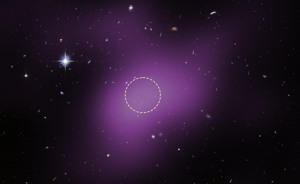
A team using the NASA/ESA Hubble Space Telescope has uncovered a new type of astronomical object — a starless, gas-rich, dark matter cloud that is considered a “relic” or remnant of early galaxy formation.
Nicknamed “Cloudâ9,” this is the first confirmed detection of such an object in the Universe.
ESA said: “The finding furthers the understanding of galaxy formation, the early Universe, and the nature of dark matter itself.”
“This is a tale of a failed galaxy,” said the program’s principal investigator, Alejandro BenítezâLlambay of the MilanoâBicocca University in Milan, Italy. “In science, we usually learn more from the failures than from the successes. In this case, seeing no stars is what proves the theory right. It tells us that we have found in the local Universe a primordial building block of a galaxy that hasn’t formed.”
“This cloud is a window into the dark Universe,” explained team member Andrew Fox of AURA/STScI for the European Space Agency. “We know from theory that most of the mass in the Universe is expected to be dark matter, but it’s difficult to detect this dark material because it doesn’t emit light. Cloudâ9 gives us a rare look at a darkâmatterâdominated cloud.”
The object is called a ReionisationâLimited Hâ¯I Cloud, or “RELHIC.” The term “Hâ¯I” refers to neutral hydrogen, and “RELHIC” describes a natal hydrogen cloud from the Universe’s early days, a fossil leftover that has not formed stars.
For years, scientists have looked for evidence of such a theoretical phantom object. It wasn’t until they turned Hubble towards the cloud, confirming that it is indeed starless, that they found support for the theory.
The discovery of this relic cloud was a surprise. “Among our galactic neighbors, there might be a few abandoned houses out there,” said STScI’s Rachael Beaton, who is also on the research team.
ESA said Cloudâ9 was simply named sequentially, having been the ninth gas cloud identified on the outskirts of a nearby spiral galaxy, Messierâ¯94 (M94).
This result has been published in The Astrophysical Journal Letters and was presented at a press conference at the 247th meeting of the American Astronomical Society.