

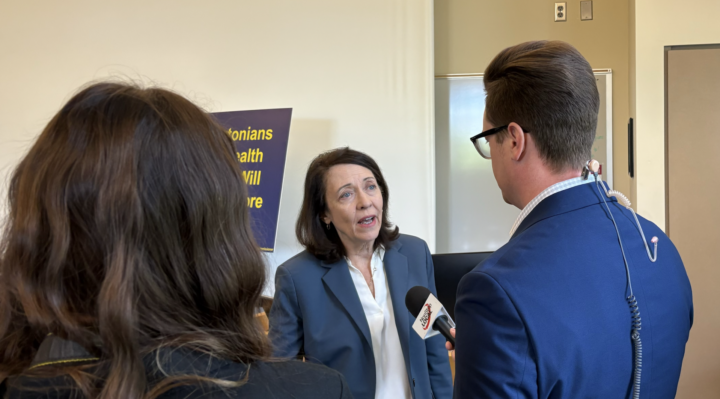
SPOKANE, WASH- Senator Maria Cantwell (D-WA) who sits on the Senate Finance Committee has been unapologetic in her disapproval of the Trump administration’s tariffs.
“[We need to not] artificially make things more expensive for consumers,” Senator Cantwell said shortly after the news was announced at the Supreme Court struck down most of the presidents tariffs.
“This is a win for consumers and small businesses,” Cantwell said Thursday, “Its clear the Supreme Court said this is a right to Congress, not the President.”
Early this year or Senator Cantwell sponsored legislation with Senator Chuck Grassley (R-IA) ensuring that Congress was the only entity to have tariff power that bi-partisan legislation requires the president to explain reasoning & impacts of new tariffs to Congress within 48 hours.
“[This legislation could be at the] center of a lot of tension, I know our Ohio colleague said today, congress should just go ahead and implement these tariffs, but my guess is that my colleague in various parts of United States strongly disagree with that,” Cantwell said.
Markets reacted positively today to the news, closing in the green.
“I think [the markets] are responding to something that was making it harder for businesses to grow that is no longer seen as legal by the Supreme Court, I mean myself, and Senator Grassley didn’t think it was legal for the president to implement them and I think that worried the market,” Cantwell said.
The senator followed up with saying she believes today’s ruling will get a lot of people questioning what role the executive branch really does play in this area.
Data indicates that the state of Washington does $127 billion worth of trade with Canada and Mexico, two areas we saw immediate tariffs.
That data breaks down into fish and seafood, and all different types of agricultural products.
“When you think about our wheat and its massive export, when you think about apples, when you think about software, when you think about airplanes, this is all about us making and growing things and selling them to markets around the world,” Cantwell said, “so we want markets to be fair and open and we don’t want to be retaliated against—and so this—the tariff issue has made it so much more costly, and has closed access to markets- and its had to get that shelf space back.”
A regular example In this conversation has been apples. The Washington State Tree Fruit Association said in a previous interview with NonStop Local that Washington’s fresh apple export is $132 million Canada and $199 million to Mexico. All in all, Canada and Mexico rank one and two when it comes to Apple trade.
The time of the interview the conversation pertaining to those two countries was uncertain.
“For example if Canada does a deal with Asia and basically gets their products on the market, why are they going to ask somebody from Othello or somewhere else in Washington, [and say] oh we will take your product back—well they already have it, we want to continue to [facilitate] open markets,” Cantwell said.
On the flip to this Congressman Michael Baumgartner (R-WA05) says in short, he sees both sides of the coin.
“There is no doubt that the tariffs have been an effective part of President Donald Trump‘s national security toolbox,” Baumgartner said, “A few months ago, I heard directly from the Prime Minister of Cambodia, who credited President Trump‘s threat of tariffs on Thailand as the key measure to end their recent border war fighting. At the same time, the lack of predictability with tariff rates creates a lot of uncertainty and challenges for many businesses and agricultural producers in Eastern Washington.”
The Congressman says he’s in support of Congress working with the president to create a trade regime.
“[this] including sanctions and trade agreements that is both useful for America’s national security interest – particularly regarding the threat of China – but also one that reasonably provides consistency, predictably, market access, and economic competitiveness to our economy. America’s businesses and farmers are the best in the world. If they can be assured of open market access and a fair, level playing field with other countries, both the American and global economies will prosper,” Baumgartner said.
The Senator on the other hand is steadfast that the tariffs not only were, not helpful but we’re hurtful– and leaves the people who paid the ultimate price for day-to-day consumers and agricultural producers in the loss of opportunity to sell their product.
“Our goal is to have fair and open markets—we believe we can compete when it’s a level playing field I think our agriculture community in particular in the Spokane region will tell you this, they see huge growth opportunities, whether that’s lentils or other products and people want to see us being aggressive—they want us to get a farm bill that funds the export market capabilities, and tariffs have been a conversation that truncates conversation,” Cantwell said.