

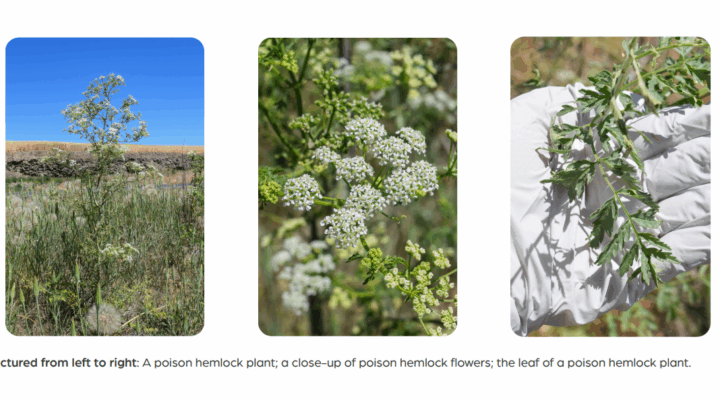
WHITMAN COUNTY, Wash. – Poison hemlock is currently blooming in Whitman County and the surrounding areas and can kill people, pets, livestock and wildlife, according to Whitman County Public Health (WCPH).
Poison hemlock is a member of the carrot family and, when fully grown, can grow six to ten feet tall. It has white flowers and bright green, fern-like leaves. The stems are hairless with purple to purple-red spots and streaks and are hollow.
It is most often found in open sunny areas, fields, vacant lots and on roadsides.
It is a toxic plant and all parts of it can be deadly. The plant’s poison, which comes from toxic alkaloids, affects the nervous system of humans and animals after ingestion and can lead to death by respiratory or cardiac failure.
There is no antidote for poison hemlock poisoning.
WCPH advised the public to do three things, the first of which is to not eat the plant.
The second thing is to learn more about disposing noxious weeds. They explained that people should wear gloves and protective clothing and remember that the toxins of poison hemlock are still effective after it has been dug up and dried out, so to be careful.
The third thing is to be aware of look-alike plants. Poison hemlock can be confused with edible members of the parkely family like fennel, chervil and anise. To be safe, they said not to handle or eat unfamiliar plants found outside.
To distinguish poison hemlock from other plants with fern-like leaves, they added, look for a completely smooth and hairless stem with purple or red spots and streaks.
For more resource on poison hemlock, they offered to answer questions at their Environmental health Program at EH@whitmancounty.org. They also referred to resources at the King County Noxious Weed Control Program, the Washington State Noxious Weed Control Board or the Washington Invasive Species Council.