

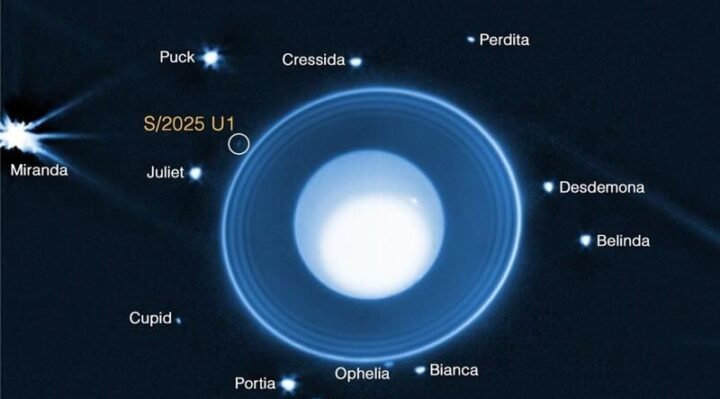
MOSCOW, Idaho – A new moon has been discovered orbiting Uranus, thanks to a team led by the Southwest Research Institute and including University of Idaho’s Matthew Hedman, a physics professor.
The team used NASA’s James Webb Space Telescope (JWST) to capture images of Uranus’s 29th confirmed satellite. This small moon joins a dense group of satellites orbiting the planet.
“This planet system pushes us to study its moons,” Hedman said. He added that the satellite system is densely packed, raising questions about the absence of moons in certain areas.
Hedman explained that computer simulations show the smaller moons orbit close enough to occasionally collide due to their gravitational interactions.
The discovery was confirmed when the moon appeared consistently in 10 long-exposure images captured on Feb. 2, 2025. Hedman noted, “One of the things that convinced us that we had a new moon was that we saw it in all 10 pictures.”
The moon, estimated to be only six miles in diameter, is currently named S/2025 U1 until an official name is given by the International Astronomical Union.
Hedman and his students will continue analyzing the images to understand the moon’s interactions and its potential role in shaping Uranus’s rings.
The University of Idaho received funding for this project from NASA’s Space Telescope Science Institute under award JWST-GO06379.005-A, with a total project funding of $18,663.