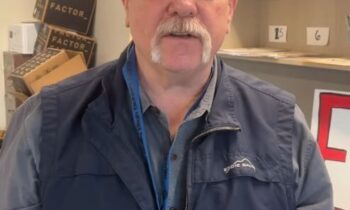


IDAHO — Cody Funke, the Idaho County Coroner, has faced significant challenges since assuming office in 2016. One of his earliest cases involved the death of Betty Strong.
The woman’s body was brought into an area hospital by her husband, who claimed she’d died of Parkinson’s disease. Trusting the widower at his word, and lacking the knowledge and resources for investigating further, Funke ruled Betty Strong’s death as natural causes.
The case served as a tough lesson for Funke. “I have a trust issue now. I don’t take what people tell me at face value. We’ve got to back it up,” he said.
Doubts in his ruling arose five years later when that same man’s second wife, Shirley Weatherly, was found dead in Texas. She had been shot in the chest, and shell casings at the scene matched a gun her husband was seen dumping on security footage, according to Parker County Sheriff’s Office.
“The deal was, is going to make us look bad? Yes. But is this a learning thing? Yes,” said Funke. “We can all learn from this. And maybe we need to step up to the plate. There’s some problems in this state.”
Now 11 years and three terms into the office of coroner, Funke says those “problems” came in the form of limited resources and little training during his first term. Those early days consisted of using his own vehicle and his personal cell phone for death investigations.
“It’s bad to say, but we’ve hauled bodies on the back of my flatbed farm pickup,” Funke said. “It was, I think, Christmas. We were sitting at the house and my youngest goes, “Ew, a dead guy,” and the photo pops up on the computer because these files had went into the screensaver.”
As for education, Idaho’s coroners are required to attend only two trainings per year, with attendance unenforced. Funke was at one of those trainings the day before he met with NonStop Local.
“About a quarter of the coroners actually showed up,” he said. “You’re going, “Where are you guys getting your training”?”
Prior to Funke taking office, his county’s coroners kept all their records on paper.
“I got three manila folders and that was all the records from start to finish to the county,” he said. “The coroner’s comment was his house had flooded and at that time they were storing all the records at home.”
Over the years, Funke has been able to create a better filing system. He also secured a camera and a work vehicle. However, he still has no physical office or morgue, telling NonStop Local he stores bodies in the fridge of his former workplace.
While his salary has increased to about $23,000 per year, Funke is still on call 24-7 and maintains a full-time job at a correctional facility to make ends meet.
Funke says a lack of funding and resources is the reality for death investigators across the state.
“We were always the last ones to see the funding,” he said. “Are we maybe necessarily the ones that should see some more of the funding because we’re the ones doing the dirty work?”
Further north, Kootenai County Coroner Duke Johnson says that “dirty work,” may be what is keeping funding out of reach.
“People don’t like to talk about death,” Johnson said. “Isn’t that interesting?”
Johnson, who was elected in 2022, says what the public is not talking about, they are not voting on either.
“I think it’s not popular for politicians to put money into that because people don’t get excited about, “Wow, we put a lot of money into death”.”
Johnson says coroners’ findings are crucial for public safety. Death investigations go beyond homicide, with results identifying bad drugs, unsafe products and more.
“When people realize that this is critical to their own safety, they convince the politicians to provide the money,” he said.
Lack of knowledge about the job has not just left death investigators underfunded. Johnson says the job is often thankless too.
“They see the evidence of murders. They see the evidence of rape, of overdose of people that were lonely and commit suicide. They have to take care of the scene that nobody else wants to touch,” he shared. “And it’s not 9 to 5–it’s 24 hours a day and it’s holidays. In fact, some of the holidays are the worst days.”
Johnson says more funding and resources will benefit not only death investigators, but their entire communities.
“It may not be popular, but it’s time for people to wake up and provide the funding that is necessary,” he said.”I have such respect for people like Mr. Funke. He is doing a tremendous service with very little resources. And he’s not alone. There’s a lot of people like him in the state.”
ProPublica Journalist Audrey Dutton has extensively reported on those other coroners and their stories for years.
“When the death investigation falls short, for whatever reason, the stakes can be quite high,” said Dutton.
NonStop Local found Coroner Cody Funke through Dutton’s reporting. She spoke about the challenges underfunded counties like his face.
“It’s an untenable position.”
Mental health support is another topic that comes up in her reporting.
“Police, every maybe 10% of the calls that they get involve traumatic deaths or like a loss of some kind. Whereas with the coroner, it’s all of them,” Dutton said.
Funke and Johnson tell NonStop Local coroners do not qualify for the same Post-Traumatic Stress Disorder Resources as other EMS.
As for key areas for that could improve, Idaho’s coroner system as a whole, Dutton says a few fundamentals come up in her conversations with coroners and deputy coroners, as well as in state surveys of death investigators.
“More autopsies, higher pay for coroners, some office space, more consistency statewide and more training,” she listed.
Johnson and Funke echo the call for these resources.
“There’s money for a lot of stuff that is not as important as this,” the Kootenai County Coroner said.
While they wait for new life in the business of death, Funke says their reality is a grim one,”It’s us against the world.”