

By Stephen Beech
Shark “turf wars” have a “profound” effect on where seabirds nest, reveals new research.
Scientists discovered a “critical” link between seasonal nesting and the movements of the marine apex predators in the remote Northwestern Hawaiian Islands.
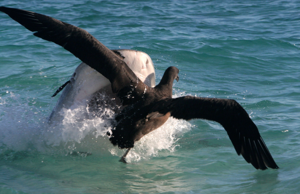
They found that the annual summer arrival of fledgling seabirds at French Frigate Shoals (FFS) concentrates tiger sharks in specific areas, forcing other species – including gray reef and Galapagos sharks – to “drastically” shift their own habitat use to avoid being attacked.
The research team says their study highlights an indirect connection between terrestrial and marine ecosystems, showing that the presence of a seasonal food source – fledgling seabirds – influences the behavior of an entire community of apex predators.
Using acoustic transmitters, the team by scientists from the University of Hawaii MÄnoa Hawaii Institute of Marine Biology (HIMB) Shark Lab tagged 128 sharks.
They tracked their movements around FFS over two years.
The researchers compared shark habitat use during the seabird season and the off-season, observing “clear” behavioral shifts.
Study lead author Chloé Blandino, of HIMB Shark Lab, said: “We discovered that tiger sharks gather around small islands in summer to hunt fledgling seabirds, which, in turn, forces other smaller sharks to adjust their habitat use.
“It was exciting to see our predictions line up so closely with reality; it’s a clear example of how a seasonal food source can influence habitat use by an entire predator community.”
The research team found that when tiger sharks are present, the smaller gray reef sharks avoid those areas completely to reduce the risk of being eaten.
Galápagos sharks shift to different times or zones within the atoll to minimize competition.
Once the seabirds disperse, the tiger sharks move on and the other shark species return to their original habitats.
The research team also used fish surveys to confirm that the shifts were driven by predator avoidance and competition, not by a change in the distribution of their usual prey.
Study co-author Dr. Carl Meyer, also of the HIMB Shark Lab, said: “This study highlights the far-reaching impact of seabirds, showing they can shape the movements of top predators like tiger sharks, which then ripple through the entire food web.”
He said: “Understanding these predator-prey links is crucial for managing Hawaii’s marine ecosystems, especially in fragile places like French Frigate Shoals, and helps protect Hawaii’s native wildlife and fragile ecosystems.”
The researchers say their findings, published in the journal Ecosphere, also highlight the sensitivity of such ecosystems, noting that if bird populations shift, or if critical nesting habitats are lost – as occurred when Hurricane Walaka decimated key islands in 2018 – it can trigger “cascading” effects.