


For perspective on changes in veterinary clinics, I asked friends online about their recent experiences with the veterinary clinics at which they’ve been clients for some time.
I asked, “Veterinarians, vet clinic staff, clients of veterinary clinics—in the United States or anywhere!—I’d like your observations of how the veterinary clinic you work at or are a client of has changed in the last few years … for the better, especially, but possibly for the worse.”
I added: “Be specific—what is the clinic doing differently now that works for you and for your pet/s? What is not working, in your opinion?”
Here are some of their answers.
Summer Storm Kingery DVM (North Carolina) As a practice owner, I have made changes that I suspect some clients will feel are “worse,” but which are enabling us to pay team members above poverty wages for our region (this is a specific defined metric) and provide health insurance, ensure that we provide care for as many patients as possible without referring to higher-cost emergency-room care, and provide high-level care for our patients while still adjusting treatment plans, when possible, for clients with fewer resources. These changes include scheduling fees (applied to the appointment if it is kept) for new clients or clients who have failed to keep multiple appointments, fees that reflect needs for overtime (an emergency fee for the third time of vomiting, for instance, calling at 4:00 p.m.), not interacting with pharmacies that use AI/computer learning to review prescriptions, and implementing strict safety policies around distressed animals that include anxiety and sedative drugs. We are no longer open on weekends because everyone deserves two consecutive days off, and we no longer offer non-medical boarding because there are better options available in our area.
Overall, we have changed our paperwork to clearly outline a zero-tolerance policy for threats and acts of violence, including racism, sexism, homophobia, and other discriminatory speech or acts. We have a policy to see our patients in urgent situations—though we may only be able to offer an admit-for-the-day option. We also can do a lot in-house, saving costs compared to specialists. We added digital radiography, dental radiography, ultrasound, and advanced anesthetic monitoring. We do provide some veterinary supervised overnight care as well.
For the near future, we are working to add mobile services for specific care (hospice, kennel, euthanasia, neonatal) and to switch our communications system (phones, internet, and texting) to have dedicated real-time team members. We’re also adding in advance monitoring for post-anesthetic and hospitalized patients. We hope to increase technician-supervised overnight care to further avoid costly emergency-room visits.
Kathleen Huggins (Washington) We haven’t used our current Spokane vet enough yet to know. We are in SoCal at our snowbird home, so we took one of ours who had a bad tooth to Mexico. $300 total—cleaning, one extraction, anesthesia, and antibiotics. She’s fine. As long as I snowbird, the majority of our vet care will be south of the border. It’s a little different than what we’re used to in the U.S., but not enough different to pay the ten times more that the U.S. vet quoted us.
Colette Kase (Mexico) Absolutely. Veterinarians in Mexico are highly skilled technicians. Small-animal veterinarians do the job only because of their passion for the work and their love of animals. Fees are incredibly low and the salary for a veterinarian is shocking. In our region, veterinarians working six days a week for 12-hour shifts often get offered the equivalent of USD $500 to $1000 a month as a salary.
Veterinarians here suffer from the same challenges that vets do in other countries and, tragically, a veterinarian in Mexico was murdered about a week ago by clients because their dog had died. The death was not the veterinarian’s fault and there have been marches around the country to show solidarity with the veterinary community.
Because of all of this, it can be difficult to access anything but basic veterinary care in some areas, as operating a fully equipped practice is expensive. Hospitals are even harder to find outside of larger urban areas with populations that can support one.
In some states, subsidized veterinary services are provided, as eight out of ten households in Mexico have pets. In fact, there are more pets than children living in households. There is also a huge overpopulation of unhoused dogs and cats, but fortunately veterinarians are committed to doing what they can to help, and most offer lowcost spay and neuter services (lower than standard fees, which are already significantly lower than you could find in the USA) and help out at mass sterilization clinics. Unfortunately, in small villages, there are no veterinary services and people do not have the resources to travel to the nearest city for veterinary care. This is where there are the most problems.
So, yes, veterinary costs are very low and medical tourism for pets is becoming more common. However, accessing some specialties such as oncology, ophthalmology, and neurology can be impossible in most of the country, as the call for these services is limited to those who can afford them.
Jules Weber (Virginia) Sort of? We use a mobile vet. Whom we love. And the owner, our original vet, got recalled into active duty. (She’s a helicopter pilot.) However, I’m happy to say that despite this major change, she’s got an amazing team. She’s not the only vet, and she started transitioning clients over to the other two vets the moment she got the news, with about one month’s lead time. Communication has stayed the same. Same techs. Same way to schedule anything you need. So yes, obviously having the owner and main veterinarian up and (temporarily) leaving is a major change, but things are still essentially the same. Which I’m grateful for!
Victoria Day (Washington) My vet clinic was down to only one vet. They finally have a full staff, I believe, because I don’t have to book out appointments far in advance. Our pet gets monthly shots and when I show up, she is in and out quickly. Although prices are up, it’s well over $1,000 to have her teeth cleaned. When I had my other two kitties, it was one-third of that price.
Linny Colucci (Washington) My previous Valley vet clinic did not change; they’ve always had sarcastic, bored, burned-out workers. I’ve cried after simple appointments because of ‘mean girl’ comments. I changed recently and am completing needed exams to see if we can do better with service and manners. My pets deserve a guardian that’s not stressed because vets and techs think I’m a punching bag. My fur babies pick up on all that.
Darcey Byrne (Washington) As you know, the original Hunter Veterinary is run by Mark Schrag, a Washington State University graduate who continues to serve many animal species. I, of course, am happy about this because … chickens!
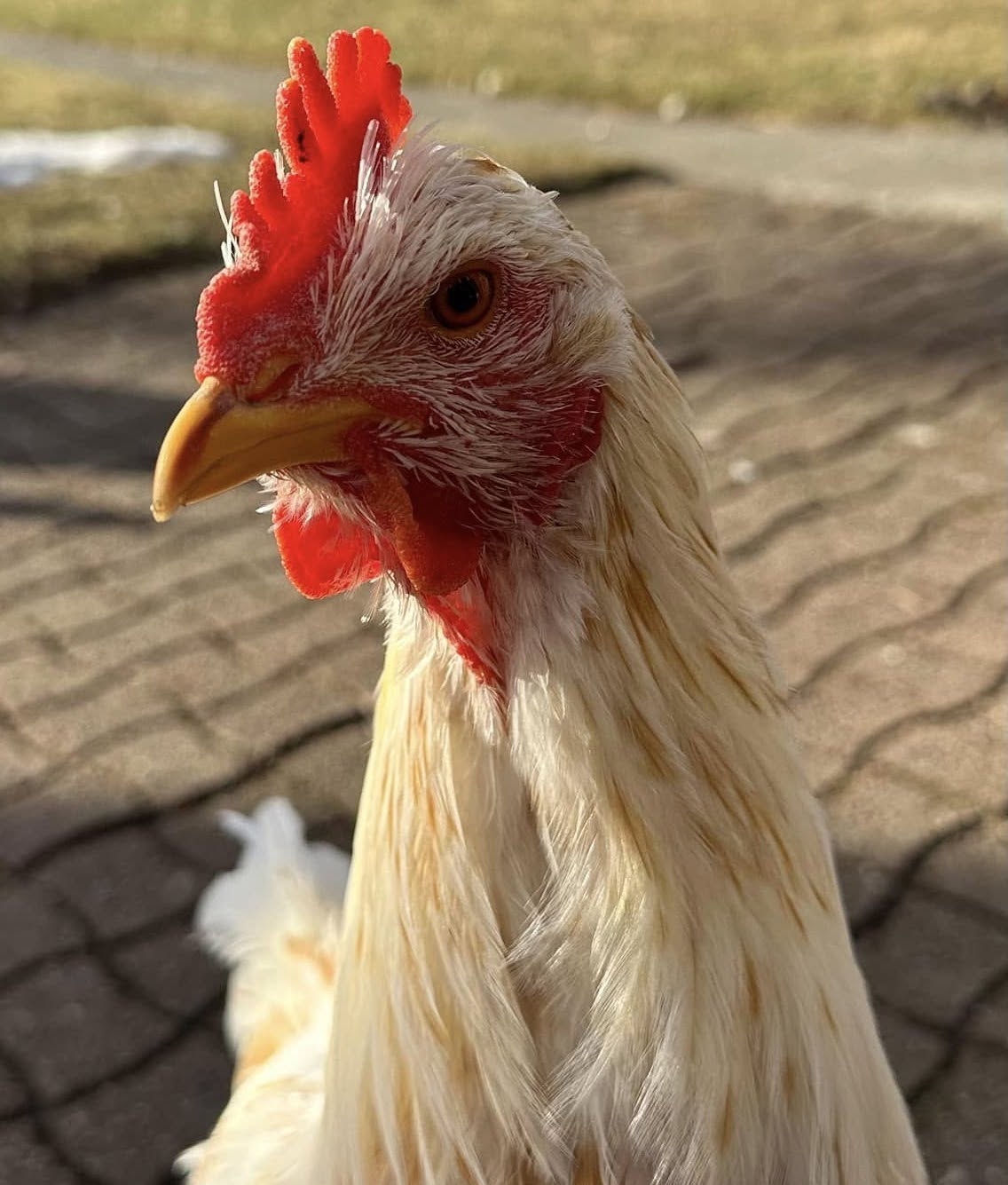
Photo by Darcey Byrne
Carol Byrnes (Washington) Two of my longest, wonderful relationships with veterinarians ended when they retired—Dr. Linda Wood and Dr. Sherry Moore. The staff and doctors at Wandermere have always been consistently kind, gentle, patient, and great doctors. And those who worked with those two and joined after [they retired] continue their level of philosophy and care!
Missy Masterson (Arkansas) During COVID, the clinics in my area all changed to curbside only—i.e., you called them from your car when you got to the clinic for your appointment and they’d come out and get your pet. Eventually, they calmed down and went back to normal operations. All except one … who still won’t let any humans inside their building! You have to give the tech your animal and stay out in your car. They have lost LOTS of business, including mine.
Kathleen Huggins We loved Millwood Clinic until the two previous vets retired and it was acquired by VCA. Different feel, different service. We’ve had a hard time finding a vet we’re truly satisfied with since.
Lori Leah Monet DVM (Colorado) I’ll give you an internal perspective. You may need a coffee. Why practices have changed—they have had to morph into the classic corporate medical/ professional mold. Forty years ago this was a passion. A calling. We looked at people and their pets as friends and neighbors. Now we are expected to provide human-level care at a cut-rate price, or we get sued or brought to the Board. No more, “Hey, how are the kids?” We don’t have the time. Younger (newer) vets are taught this is a business … not a passion. Not a compassion. I got called out for talking to a six-year-old about her school day. By the MOTHER, who claimed I ignored HER. Same when I talk “to” the pet. It is my way of engaging the owner. “Hey, Fluffy, does Mom give you good food?” The good owner then replies what food. The Karens chastise me for not being professional.
But, to the question … Practices are no longer mom and pop. They are, for the most part, corporate or conglomerate owned. Time is money. More patients in less time.
Now add “standards of practice.” We are expected to use the newest and fanciest equipment. It isn’t cheap. And we are expected to use it even if we don’t need it because one in a hundred times we may be wrong. Or we may have an adverse outcome (all medical procedures run that risk). So we need to make that money back … and clients find us overpriced.
And litigation. Being sued because we didn’t do all the above when the client cannot afford it or is unwilling to pay for it. Oh, and Fluffy has a scar. The client now claims the pet is not chattel but an integral part of the family. Yet the client still won’t pay the price that they would for their child’s care.
We are playing defensive medicine. We may know, without a doubt, what the diagnosis is and we could treat it with an inexpensive medicine, but now because of litigation, comparing to human hospitals, corporate bean-counting, and teaching new vets that there is only ONE way to treat (it used to be an art), we must over-diagnose, over-medicate, and defend against the top-gun newbie who “knows it all” down the road—who in another, earlier life was a colleague and not a cut-throat competitor.
When I started forty years ago, we were in the top five respected professions. Because of all the above … we are not even on the list now.
I am glad to say that among friends locally, including several who’ve responded here, there are current clients of local veterinary practices who remain happy, as I have been, with the services (and attitudes) they receive when they take their pets in for care. If you are not satisfied with the care you and your pet/s are getting at a veterinary clinic, ask friends and family about the clinics they choose and consider how best to find veterinary care that might better suit you and your pets.