

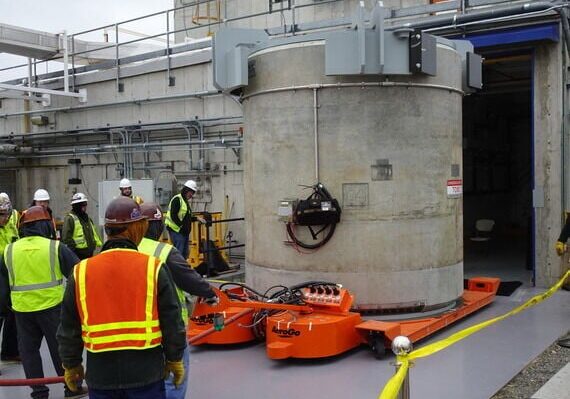
RICHLAND, Wash. – The Hanford Site recently completed a transfer of the first batch of radioactive capsules from underwater pools to long-term dry storage, according to a press release from the Washington Department of Ecology.
“This initial transfer marks a major milestone in efforts to reduce one of Hanford’s largest environmental risks,” DOE said. “Over the next several years a total of 1,936 capsules containing cesium and strontium, making up about one-third of the total radioactivity at the site, will be moved into large concrete casks and placed in outdoor storage.”
Cesium and strontium at the Hanford Site are a byproduct of the site’s former plutonium production, according to the DOE. The water pools the capsules were previously stored in shielded their radioactivity and helped remove heat, but if an earthquake or other event were to rupture the water basin, it would pose a serious risk.
The transfer of these capsules to dry storage casks are intended to reduce that risk, the DOE said. The casks are connected to temperature sensors and provide “passive cooling for the capsules and robust shielding to protect workers and the environment.”
The capsules will remain in the casks until radiation has reduced to safer levels and a final disposal plan is put in place.
“This is a significant step for safety at Hanford,” Governor Bob Ferguson said. “Thank you to the workers performing this complex and important work. Transferring these capsules of waste to safer, long-term storage will help protect workers, communities and the environment for generations to come.”
The Hanford Site was established in 1943 as a plutonium production plant for the Manhattan Project during World War II. It was the design and construction site for the world’s first plutonium-producing reactor, which produced plutonium for the Trinity Test and the atomic bomb dropped on Nagasaki, Japan.
The U.S. Department of Energy, Environmental Protection Agency and the Washington State Department of Ecology entered into the legally-binding Tri-Party Agreement to clean up radioactive waste at the Hanford Site in 1989.
As part of the Tri-Party Agreement, it was agreed that all capsules must be moved to dry storage by September 30, 2029.
For more information, visit Hanford.gov.