

Opponents of Washington’s new income tax on high earners filed a lawsuit Thursday, arguing the controversial law is unconstitutional and in conflict with nearly a century of state Supreme Court precedent.
This marks the start of a much-anticipated legal brawl over the law, which Gov. Bob Ferguson signed late last month. Dubbed the “millionaires’ tax” by backers, it imposes a 9.9% tax on household wage earnings above $1 million a year.
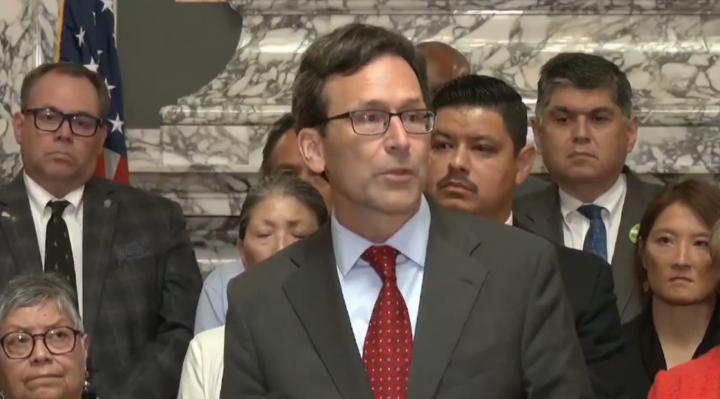
“We are challenging an illegal, unconstitutional income tax that clearly flies in the face of the constitution, of precedent and of voter will,” said former state attorney general Rob McKenna, who is running point on the effort to invalidate the law.
The core argument opponents of the tax make is that income is property and, according to the state constitution, property taxes must be applied uniformly and cannot exceed a rate of 1%. This makes graduated or progressive income taxes unconstitutional, they contend.
They also point out that the state Supreme Court has held that income is property, including in a precedent-setting ruling in 1933.
McKenna, former state Supreme Court justice Phil Talmadge and Jackson Maynard, executive director of the Citizen Action Defense Fund, are the lead attorneys on the case.
The lawsuit was filed on Thursday in Klickitat County Superior Court. The lead plaintiffs are Benjamin and Laura Petter, a married couple. Benjamin Petter is a builder, Laura Petter owns a marketing business and together they would be subject to the tax, the lawsuit says.
Other individuals are also signed on as plaintiffs, along with the Ethnic Chamber of Commerce Coalition, the Yakima Klickitat Farm Association, the Building Industry Association of Washington, and the National Federation of Independent Business.
Invest in Washington Now, an advocacy group backed by unions representing state employees, teachers, and other workers, blasted the lawsuit, saying that polling shows the tax is popular and that “extremist groups are doing everything they can to shield billionaires and mega-millionaires from paying what they owe our communities.”
“They want our state’s working families to keep paying up to three times higher tax rates than those with the greatest wealth,” the group added.
Headed for the Supreme Court
Talmadge speculated that it could be early next year before the case is argued before the state Supreme Court. He said he hopes that the high court will take the case directly from the superior court, eliminating a step in appeals court.
Maynard called the suit “one of the most consequential in state history.”
Senate Majority Leader Jamie Pedersen, D-Seattle, a lead sponsor of the tax, said Wednesday the legal challenge is “expected and welcomed.” He said one of the purposes of the bill was to get the legality of a progressive tax in front of the state’s high court for review.
“It’s great,” he said. “We will now have that robust argument.”
Gov. Bob Ferguson signed Senate Bill 6346 on March 30. It took effect immediately, ending Washington’s status as one of a handful of states that do not tax individual wage and salary income.
Supporters of Washington’s new income tax on millionaire earners celebrate after Gov. Bob Ferguson signs the bill into law on Monday, March 30, 2026. (Aspen Ford/Washington State Standard)
Collections would begin in 2029 and generate around $3 billion a year from an estimated 21,000 filers. That’s if the tax withstands this test in the courts and an expected challenge on the ballot.
Washington voters approved an income tax in 1932. But a year later, a divided state Supreme Court tossed it. Since then, voters have rejected variations of the idea multiple times, most recently in 2010 when the income threshold for individuals was $200,000.
The Citizen Action Defense Fund, a nonprofit, declared its intent to challenge the new law the day Ferguson signed it and said then that McKenna, a 2012 Republican candidate for governor, would steer the legal team. Maynard said that a variety of large and small donors are funding the legal fight.
Backers of the tax are confident in the law’s legal sturdiness. They also think the passage of time and the evolution of the state Supreme Court’s composition will result in a different outcome than 93 years ago.
McKenna takes the view that the state can adopt an income tax as long as it is set at the same rate on all levels of income. Or, in the alternative, the Legislature and voters can agree to amend the state constitution to include a specific income tax, such as the one envisioned in the new law, he said.
“They seem to think members of the Supreme Court will do what they were unable to do themselves, which is to amend the constitution,” McKenna said.
The lawsuit notes that Washington voters have rejected income tax measures on 10 occasions since 1933. This included six proposed constitutional amendments.
Attorney General Nick Brown will wage the fight for the law on behalf of the state.
“We will be defending the constitutionality of this law in court and expect to prevail,” Deputy Communications Director Mike Faulk wrote in an email Wednesday. “We’ll preserve our legal arguments for the anticipated filings.”
Pedersen, who is a lawyer, said not to be surprised when the superior court judge who gets the case rules the law is unconstitutional. Trial courts, he said, must follow Supreme Court precedents.
“Ultimately, this is a case that will be decided by the nine justices of the Supreme Court,” he said.
Parallel referendum fight
In a separate legal tussle, the state Supreme Court could decide at the end of the month whether foes of the tax should be allowed to pursue a referendum, giving voters a chance to reject the law.
Brian Heywood, founder and chief financier of the conservative political committee Let’s Go Washington, filed a referendum after the law was signed. But Secretary of State Steve Hobbs rejected it, citing language expressly prohibiting such a vote.
Heywood then filed an emergency petition with the Supreme Court asking it to direct Hobbs to process the paperwork. The court accepted the petition and is scheduled to discuss it in an April 30 conference.
Should the court side with Heywood, opponents of the tax must submit signatures of 154,455 voters by June 10 to qualify for the fall ballot. State election officials recommend submitting close to 200,000 to account for invalid signatures.
If the referendum effort is blocked, opponents of the tax could try for an initiative to overturn the law. But qualifying an initiative would require more signatures and, therefore, more time and money.
The full lawsuit can be seen below.
Washington State Standard is part of States Newsroom, a nonprofit news network supported by grants and a coalition of donors as a 501c(3) public charity. Washington State Standard maintains editorial independence. Contact Editor Bill Lucia for questions: info@washingtonstatestandard.com.
© 2026 KAYU FOX 28. All rights reserved. Content may not be reproduced, distributed, or transmitted without written permission.