
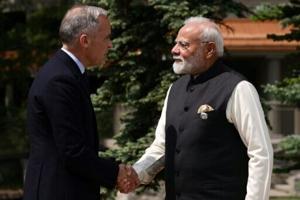
Canadian Prime Minister Mark Carney flies to Asia on Thursday for a three-country tour with a first stop in India, where he hopes to double trade to offset the damage of his country’s fracturing relations with the United States.
Carney’s India visit marks the latest effort to reset bilateral ties that effectively collapsed after Ottawa accused New Delhi of orchestrating a deadly campaign against Sikh activists on Canadian territory.
For Carney, the trip that includes stops in Australia and Japan is part of a broad effort to pivot the Canadian economy away from excessive reliance on its southern neighbor.
In 2024, before US President Donald Trump returned to office and upended global trade through a flurry of tariffs, more than 75 percent of Canadian exports went to the United States. Two-way trade that year exceeded $900 billion.
US tariffs targeting specific sectors have hurt the Canadian economy over the past year.
But Trump has so far broadly adhered to the North American free trade agreement he signed during his first term and 85 percent of US-Canada trade remains tariff-free.
The US president has said, however, that he may scrap that deal, calling it “irrelevant” with “no real advantage” to the United States.
Carney has made boosting commerce with Europe and Asia cornerstones of his strategy to backstop Canada’s economy, should free trade with Washington collapse.
University of Toronto public policy expert Drew Fagan said Carney was wise to pursue other markets, calling for a strategy that seeks to do “more elsewhere, when there’s an opportunity.”
The prime minister has said he wants to more than double two-way trade with India by 2030, eyeing a target of Can$70 billion ($51 billion) by 2030.
Fagan cautioned that progress with countries like India cannot mitigate the damage of a US rupture.
“It’s not a solution. It’s not a replacement and it never will be,” Fagan told AFP.
– Transnational repression –
Carney’s outreach to India is facing domestic scrutiny and his talks with Indian Prime Minister Narendra Modi will be closely watched.
Before Carney took office last year, Ottawa accused Modi’s government of direct involvement in the 2023 killing of Hardeep Singh Nijjar, a naturalized Canadian citizen who advocated for an independent Sikh state called Khalistan.
Former prime minister Justin Trudeau’s government further charged India with directing a campaign of intimidation against Sikh activists across Canada.
India has denied those allegations.
Canadian Foreign Minister Anita Anand was asked Monday if Canadian concerns about transnational repression would feature at the New Delhi talks.
“Yes, that is always at the forefront of our minds,” Anand told reporters in Ottawa.
Carney’s hopes for trade growth with Australia and Japan are more modest, but his office said cooperation over critical mineral supply chains will be a priority.
Advanced economies have made a push to deepen critical mineral cooperation, especially in the processing of rare earth elements essential to power many high-tech products.
China currently has dominant control of rare earth supply chains, a concern that Canada highlighted throughout its just-concluded G7 presidency.
bs/aha