
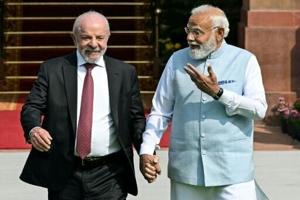
India and Brazil agreed to boost cooperation on critical minerals and rare earths on Saturday, Prime Minister Narendra Modi said after talks in New Delhi with Brazilian President Luiz Inacio Lula da Silva.
“The agreement on critical minerals and rare earths in a major step towards building resilient supply chains,” Modi said.
Brazil has the world’s second-largest reserves of critical minerals, which are used in everything from electric vehicles, solar panels and smartphones to jet engines and guided missiles.
India, seeking to cut its dependence on top exporter China, has been expanding domestic production and recycling while scouting for new suppliers.
“Increasing investments and cooperation in matters of renewable energies and critical minerals is at the core of the pioneering agreement that we have signed today,” Lula said.
The details of the deal were not immediately available.
Nine other agreements and memoranda of understanding were finalised on Saturday, the foreign ministry’s spokesman said, touching on digital cooperation, health, entrepreneurship and other fields.
“Brazil is India’s largest trade partner in Latin America. We are committed to taking our bilateral trade beyond $20 billion in the coming five years,” Modi said.
“Our trade is not just a figure, but a reflection of trust.”
Lula, who arrived in New Delhi on Wednesday for a summit on artificial intelligence, is accompanied by a delegation of more than a dozen ministers as well as business leaders.
On Saturday, he was given a ceremonial welcome and paid his tributes to India’s independence hero Mahatma Gandhi, before going into the meeting with Modi.
With China holding a near-monopoly on rare earths production, some countries are seeking alternative sources.
Rishabh Jain, an expert with the Delhi-based Council on Energy, Environment and Water think tank, said India’s growing cooperation with Brazil on critical minerals complements recent supply chain engagements with the United States, France and the European Union.
While these partnerships grant India access to advanced technologies, finance and high-end processing capabilities, “Global South alliances are critical for securing diversified, on-ground resource access and shaping emerging rules of global trade”, Jain told AFP.
– ‘New momentum’ –
India, the world’s most populous nation, is the 10th largest market for Brazilian exports, with bilateral trade topping $15 billion in 2025.
Key Brazilian exports to India include sugar, crude oil, vegetable oils, cotton and iron ore.
Demand for iron ore has been driven by rapid infrastructure expansion and industrial growth in India, which is on track to become the world’s fourth largest economy.
India’s Foreign Minister Subrahmanyam Jaishankar said he was confident that Lula’s talks with Modi “will impart a new momentum to our ties”.
Modi said that “our cooperation in the defence sector is also continuously growing,” hailing a “win-win partnership”.
“When India and Brazil work together, the voice of Global South becomes stronger and more confident.”
Brazilian firms are also expanding in the country, with Embraer and Adani Group announcing plans last month to build aircraft in India.
Lula addressed the AI Impact summit in Delhi on Thursday, calling for a multilateral and inclusive global governance framework for artificial intelligence.
He will travel on to South Korea for meetings with President Lee Jae Myung and to attend a business forum.
abh/ami